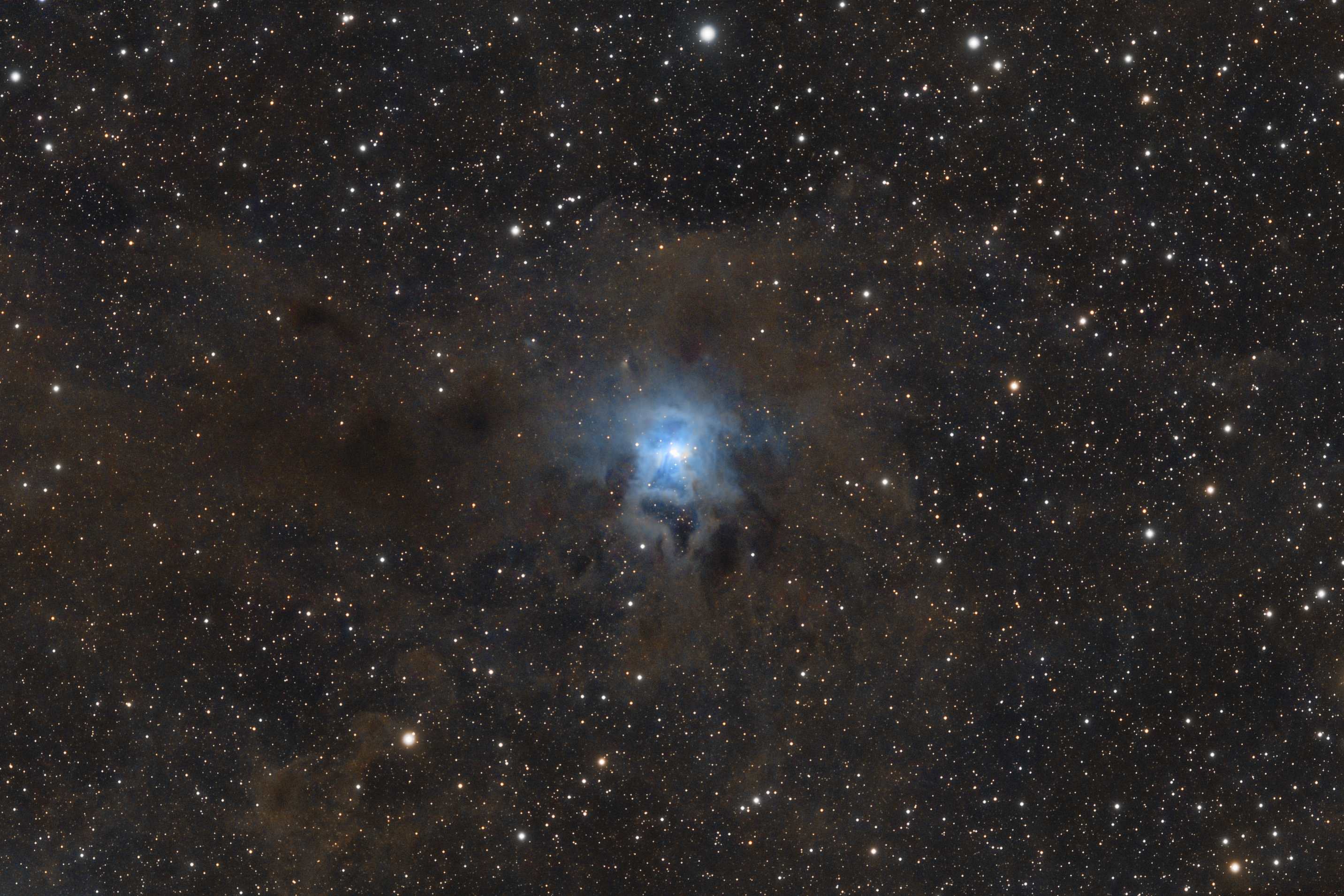
Here’s the Iris Nebula. It’s a dark nebula in the constellation of Cepheus. The Iris itself is quite bright but it’s surrounded by a dark nebula that’s quite tricky to capture in light polluted skies. I imaged this target because I wanted to compare how a my Bortle 6 sky compares to Bortle 1 in Wales. I thought this would be a disaster from my location but actually it turned out much better than I thought it would. It’s also taken using HDR mode on my Touptek IMX585 using the new 4.36 firmware. It seems that this finally works ok after a year of waiting
Skywatcher Evoguide 50ED with Starizona Flattener, Az-Gti, UV filter, Risingcam IMX585, guided, 9hrs of data
Veil Nebula Mosaic
20 Jul 2024
I was determined to get a mosaic of the Veil Nebula. This one consists of three panels of ~10hrs each. It could really do with more panels on the top and the bottom to get the entire nebula, but this is done for now. I want to move onto a Sadr mosaic. It was stacked and processed in Siril alpha build using astrometric registration. I followed my narrowband workflow and my mosaic with Siril workflow.
Skywatcher Evoguide 50ED with Starizona Flattener, az-gti, sv220 narrowband filter, Risingcam IMX585, guided, 3 panels of ~10hrs each
Butterfly Nebula IC1318
20 Jul 2024
Last night was the second night I’ve used my new Onstep converted EXOS2 (a EQ5 class mount) so I thought I’d try a different target. I’ve always liked the Sadr region and other than the Crescent Nebula, I’ve not yet imaged it. I’ve seen some fantastic pictures of the Butterfly Nebula so I thought I’d give it a try to see how well I could do. Here’s the result from just 3hrs of imaging. I’m so impressed that I’m now planning a mosaic of the region.
Skywatcher Evoguide 50ED with Starizona Flattener, EXOS2 with Onstep, sv220 narrowband filter, Risingcam IMX585, guided, ~3hrs of data
Western Veil Nebula NGC6960
21 Jun 2024
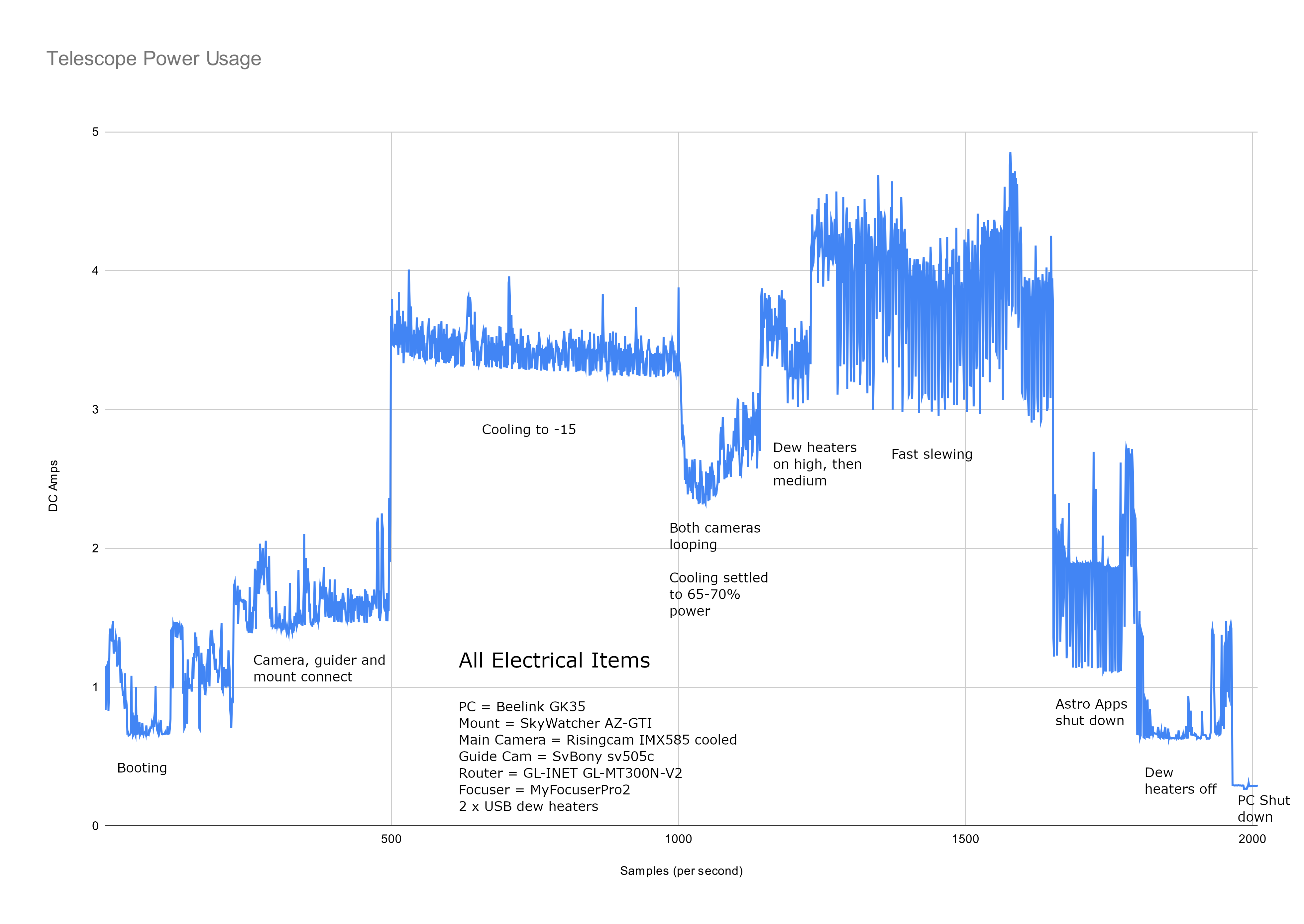
I’ve had many clear nights recently and I’ve managed to gather just over 13hrs of data on the Western Veil Nebula aka Filamentary Nebula aka Witches Broom & Pickerings Triangle. This is a very rewarding target but is harder to get right that it seems. There’s a LOT of stars in this region which need dealing with and a lot of faint nebulosity which demands a long integration to bring out of the noise. I could spend many more nights on this but I think it’s looking ok so I’ll move on to the next target, which may be more of the Veil Nebula
Skywatcher Evoguide 50ED with Starizona Flattener, az-gti, sv220 narrowband filter, Risingcam IMX585, guided, ~13hrs of data
Power Usage Measurements
04 Jun 2024
I decided to do an experiment this evening. I hooked my multimeter inline between my battery and my equipment. I then hooked it via USB to my laptop & logged the output. I then plotted it on a graph so I could see the effects of using particular equipment. The graph is below, but the highlights are that with camera cooled, dew heaters on & imaging, the steady state power usage is ~3.75a. Slewing can add another amp on top of that for a short period of time. My power supply is just 5a so at times I’m skirting close to the limit but I’ve not had an issue so far. My battery is 50ah so it should keep this lot running for an entire evening without problems.